
The web is moving into a new division of labor. For years, we have kept CMS platforms, application servers, and databases online so that every page request can assemble content at runtime. But when AI can understand content, modify source files, coordinate multiple languages, validate changes, produce diffs, and trigger deployment, information-heavy websites can move more work to the moment when content changes.
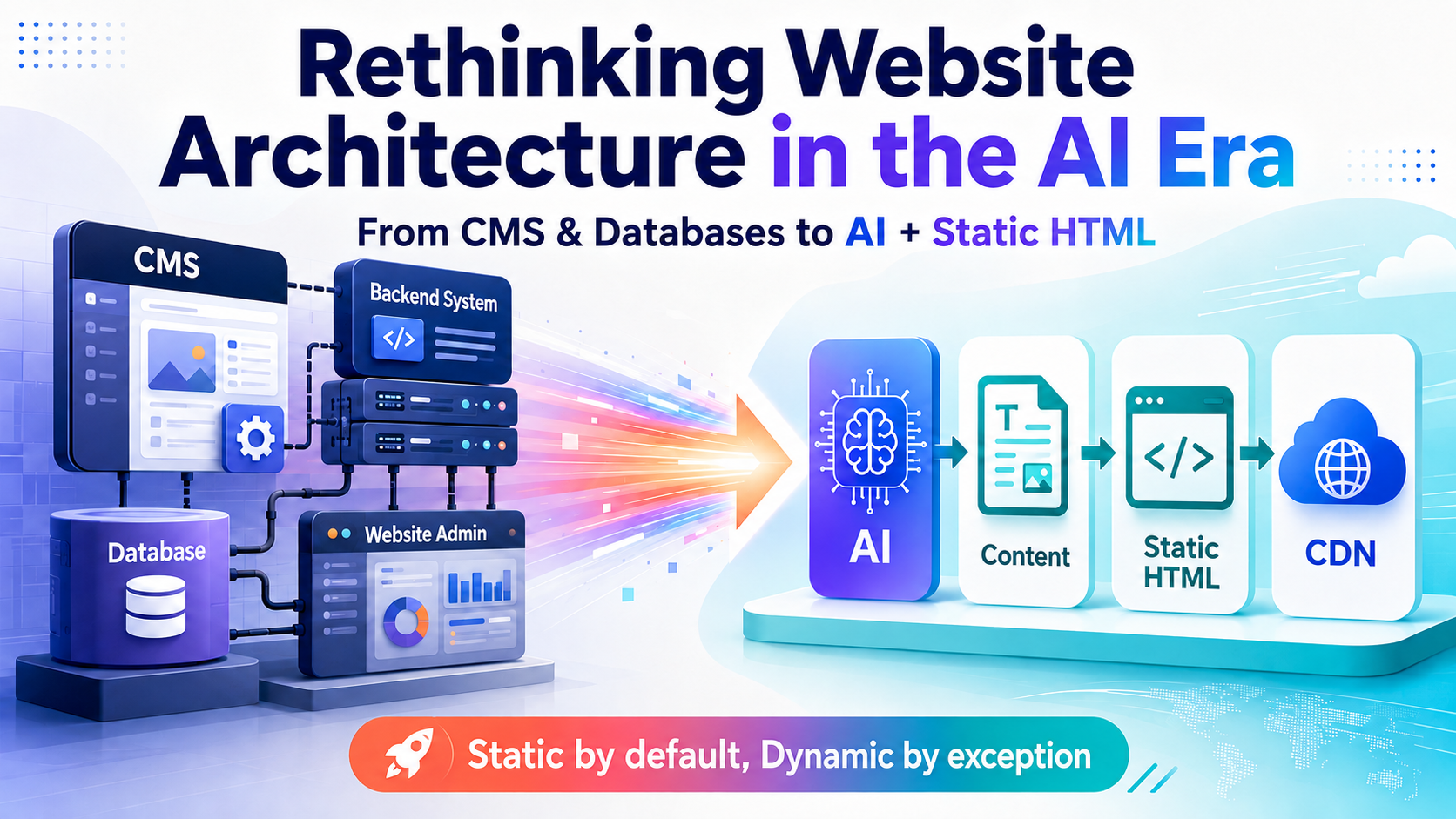
01 — THE OLD MODELWhy did information websites need a CMS and database in the first place?
Traditional websites tied content management to website execution for good reasons. Companies needed non-engineers to update company information, products, news, FAQs, images, and multiple languages. CMS platforms provided logins, fields, forms, permissions, drafts, reviews, and publishing. To make that work, content was commonly stored in a database and assembled into pages by backend code and templates at runtime.
Traditional information website
- 01CMS admin interface
- 02Backend application
- 03Content database
- 04Templates / API
- 05Pages assembled on request
AI-native information website
- 01Human intent / AI Agent
- 02Structured content
- 03Validation / versioning
- 04Build / preview / approval
- 05Static HTML / CDN
The tension is that most corporate sites, public information sites, documentation portals, and product information websites are overwhelmingly read-oriented. Only a small portion of pages may change on a given day, yet the CMS, database, and application runtime remain online all year.
02 — RECONSIDERHave we made too many websites dynamic by default?
If 90% of a site consists of About, Products, Solutions, News, ESG, Investor Relations, FAQ, and Contact pages, the common pattern is simple: the site is read-heavy and publish-oriented. Content changes, but visitors do not necessarily need a live database query every time they read it.
That leads to a useful distinction: content authors may need dynamic tools, but content delivery does not always need a dynamic runtime.
03 — AI ENTERS THE STACKAI changes the authoring model, not just HTML generation
The traditional CMS interface is a collection of forms. Editors log in, locate a page, locate a field, edit it, preview it, and publish. In an AI-native workflow, the interface can become intent. An editor might simply say:
Sync English, Japanese, and Korean, but keep the existing Japanese company-name translation.
Show me every affected page and the diff before publishing.
An AI Agent can search the content base, understand context, update the canonical source, apply locale rules, run validation, generate previews and diffs, and hand the result to a human for approval. At that point, the most valuable parts of a “CMS” shift away from form entry and toward governance, permissions, versioning, review, and reversibility.
04 — SOURCE OF TRUTHStructured content matters more than page-shaped content
For AI to operate reliably across a large website, content has to be understandable. Compared with information embedded directly inside one-off page layouts, structured content is easier to search, validate, translate, update in bulk, and reuse across channels.
The important question in the AI era may be less “What does the CMS UI look like?” and more “Is the content model clear, stable, and machine-verifiable?”
05 — THE CORE SHIFTFrom runtime generation to change-time generation
In a traditional dynamic site, most page-generation work happens when visitors request content. In an AI-native, static-first model, more work happens when content changes.
This does not mean “no backend.” It means the backend role shifts from a serving backend toward an authoring backend: a system that helps create, validate, and publish content instead of assembling every page for every visitor.
06 — PRACTICAL EXAMPLEMultilingual corporate websites are an ideal starting point
Multilingual corporate websites are a strong example because traditional CMS implementations often accumulate page translations, menu translations, SEO metadata, locales, revisions, and workflow relationships. An AI-native model can instead maintain canonical content plus locale rules and generate regional versions from that source.
- The AI searches every relevant page and reference.
- It updates canonical content instead of editing each page manually.
- It applies terminology and localization rules for each locale.
- It updates titles, descriptions, Open Graph data, and structured data where required.
- It checks links, formatting, dates, brand names, and content consistency.
- It produces a preview and diff for approval.
- It builds the Static HTML versions and deploys them through a CDN.
The job is not merely translation. It becomes Translation → Localization → Validation → Publish.
07 — THE BOUNDARYWhich features should stay dynamic?
Static-first does not mean databases disappear. Features with transactions, identity, mutable state, or real-time data still belong behind APIs, serverless functions, application servers, and databases.
Company pages, product information, news, documentation, FAQ, ESG, investor relations, campaign pages, brand content, and SEO landing pages.
Membership, login, orders, inventory, payments, booking, CRM, personalized dashboards, real-time quotes, and transactional data.
The practical principle is not static versus dynamic as a binary choice. It is Static by default, Dynamic by exception.
08 — THE FUTURE OF CMSCMS does not disappear. It gets redefined.
AI can update one page or ten thousand pages at once, so governance becomes more important, not less. A mature AI content workflow needs much more than generation.
The importance of the form-based CMS interface may decline, while the importance of content governance increases.
09 — A SECOND USERWebsites increasingly serve humans and AI Agents
For most of the web’s history, the assumed user was a human in a browser. AI search, AI browsers, and autonomous agents introduce a second kind of consumer: software that needs to understand and sometimes act on the site.
This makes complete HTML, semantic markup, structured content, and stable URLs more valuable again. They affect not only performance and search visibility, but also whether AI systems can understand and operate on the website correctly.
10 — THE BLUEPRINTWhat can an AI-era information website look like?
↓
AI Agent
↓
Structured Content / Content API
↓
Git / Versioning / Policy
↓
Build + Validation + Test
↓
Preview + Diff + Approval
↓
Static HTML
↓
CDN → Humans / Search / AI Agents
Dynamic features → API / Serverless → Database
This is a hybrid architecture: information content is static by default, while features that require identity, transactions, or real-time state stay dynamic. The runtime surface becomes smaller, faster, and easier to scale.
Key questions about the shift
Does a static website mean updates cannot be immediate?
No. A content change can trigger a new build and deployment immediately. For information-heavy websites, the experience can still feel close to real time; the computation simply happens at publish time instead of page-request time.
Does the AI era mean websites no longer need databases?
No. Databases remain essential for accounts, orders, inventory, payments, transactions, and real-time state. What changes is that published information does not always need a runtime database query to render.
Will AI replace the CMS?
More likely, it will redefine it. Form-based interfaces may matter less, while permissions, schemas, versioning, review, diffs, audit trails, and rollback become more important.
Is it risky to let AI modify a website directly?
Yes, if the workflow stops at generation. A mature system also needs validation, testing, preview, diff, approval, and rollback. AI can execute changes, but production publishing still needs governance.
Which websites are the best candidates for static-first architecture?
Corporate sites, multilingual information sites, public information portals, documentation, brand-content sites, product information sites, and large sets of SEO landing pages are strong candidates.
How is this different from traditional static site generation?
The core web technology is not entirely new. The new part is that AI Agents can participate directly in content understanding, bulk edits, localization, validation, preview, diff, and publishing, making static workflows easier to operate through intent rather than engineering-only tooling.
11 — CONCLUSIONThe backend does not disappear. Its job changes.
The most useful question in the AI era is not simply whether AI should build websites. It is whether a website designed mostly for reading and publishing still needs the same heavy runtime architecture we became accustomed to.
When content can be structured and versioned, AI can understand update intent, build pipelines can validate and generate pages, and CDNs can deliver complete HTML directly, many websites can move from generating content on every request to generating it when the content changes.
Static by default, Dynamic by exception is not only a performance strategy. It may become one of the defining architecture principles of the AI-native web.
Explore more website-building ideas
Continue with practical guides on multi-page systems, responsive design, AI-assisted building, and modern publishing workflows.
Back to Website Building →