
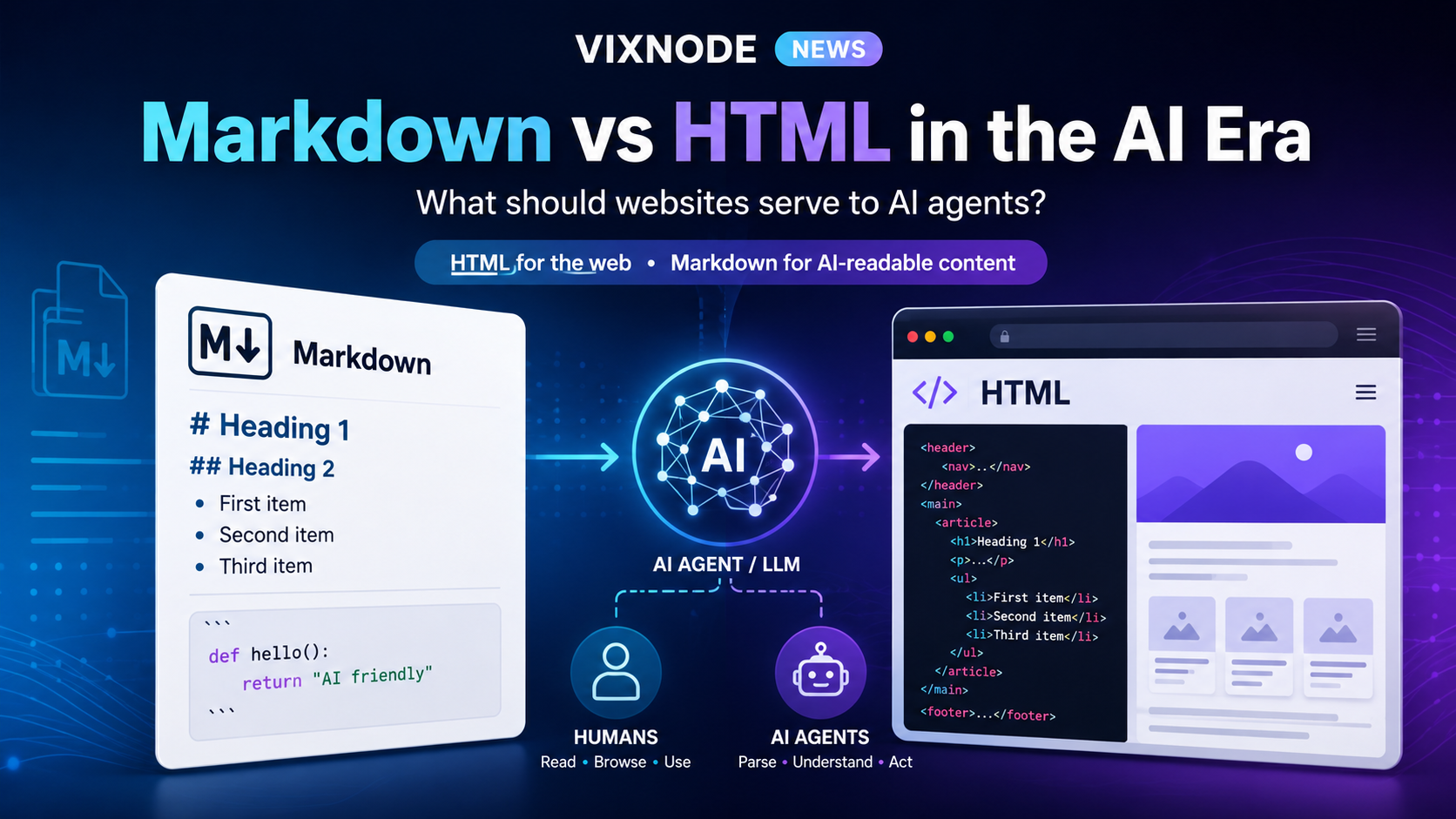
For years, Markdown versus HTML was mostly a question about writing convenience: which is easier to author, which works better for documentation, and which belongs on websites. In the AI agent era, the question has changed. Websites are no longer read only by humans and search engines. They are also consumed by LLMs, RAG systems, and agents that browse the web on a user’s behalf.
That raises a new architecture question: should a modern website provide more than HTML and expose a cleaner representation that machines can read with less overhead?
1. Why Markdown vs HTML Is a Debate Again
HTML remains the foundation of the web. Browsers use it to build document structure, search engines extract headings, paragraphs, links, images, and semantics from it, and interactive elements such as buttons, forms, and navigation live in the DOM.
Markdown was designed for a different purpose. It compresses headings, lists, links, code, and paragraphs into a readable plain-text structure. When an AI system only needs to understand an article, that reduced boilerplate can be appealing.
Content first
Compact, readable, and easy to chunk. Well suited to articles, documentation, RAG pipelines, and LLM context.
Web first
Preserves semantics, DOM relationships, forms, navigation, structured data, and interaction for browsers, search, and agents that act on pages.
2. HTML Describes the Web. Markdown Describes Content.
HTML is not simply another text format. Elements such as <nav>, <article>, <form>, <button>, and <label> describe roles and relationships inside an interface.
<nav>...</nav>
<article>
  <h1>AI Web Design</h1>
  <p>...</p>
</article>
<form>
  <label>Email</label>
  <input type="email">
  <button type="submit">Sign in</button>
</form>
Markdown can preserve the article beautifully, but it does not fully express that a form can be submitted, which label belongs to an input, whether a button is disabled, or what state a browser interface is currently in.
3. Why AI Agents Like Markdown
Real-world HTML often contains far more than the main content: navigation, cookie banners, tracking code, CSS classes, SVG, recommendation modules, interface wrappers, and other page chrome. For a model that only needs to summarize a page or index it into a knowledge system, much of that becomes extra context.
Markdown therefore has three practical advantages in content-only workflows: it can be cleaner, it can require fewer tokens, and it tends to preserve document hierarchy in a simple form. Research such as ReaderLM-v2 also reflects this demand by explicitly converting complex HTML into clean Markdown or JSON for downstream language-model use.
4. Reading a Website and Operating a Website Are Different Tasks
Read / summarize / retrieve
For articles, documentation, and knowledge retrieval, Markdown can be an efficient representation.
Navigate / input / execute
When an agent needs DOM structure, form state, ARIA semantics, or interaction results, HTML and the browser environment matter more.
This is why “agent-friendly” should not be reduced to “convert everything to Markdown.” An agent that signs in, searches, chooses a plan, fills a form, or confirms an action still needs to understand the actual web interface.
5. `Accept: text/markdown`: One URL, Two Representations
In 2026, Cloudflare introduced Markdown for Agents. On enabled sites, an AI client can request the same URL with Accept: text/markdown, and Cloudflare can return a Markdown representation of the source page when possible.
GET /article
Accept: text/markdown

HTTP/2 200
Content-Type: text/markdown
Vary: Accept
The important idea is that the URL does not need to change. A browser can receive HTML while an agent that prefers Markdown receives a lighter content representation. The site does not necessarily need a second article URL.
6. Google Search Does Not Require Markdown
Google’s 2026 guidance for generative AI features in Search explicitly states that sites do not need llms.txt, special AI text files, special markup, or Markdown to appear in Google Search’s generative AI experiences. Those files do not receive a special visibility or ranking advantage in Google Search.
Google’s generative AI experiences still rely on the existing Search index and core ranking and quality systems. That means the familiar foundations remain important: crawlable pages, clear technical structure, useful original content, and sound SEO.
It can be useful as an interface for other agents or LLM systems, but it should not replace normal HTML SEO.
7. Where Does `llms.txt` Fit?
/llms.txt is a Markdown-based proposal for giving language models and agents a concise description of a site plus links to important resources. It is better understood as an AI-readable discovery layer than as a replacement for sitemap.xml.
Today, the safest interpretation is to treat it as an optional interface for AI tools that choose to use it, not as a Google ranking factor.
8. Markdown vs HTML: Which Format Fits Each Use Case?
| Use case | Markdown | HTML | Recommendation |
|---|---|---|---|
| Human-facing website | Limited | ★★★★★ | HTML |
| News / blog publishing | ★★★ | ★★★★★ | HTML first |
| SEO and Google Search | ★★ | ★★★★★ | HTML |
| Structured Data | ★ | ★★★★★ | HTML + JSON-LD |
| AI agent reading articles | ★★★★★ | ★★★ | Markdown |
| LLM context / RAG | ★★★★★ | ★★★ | Markdown |
| Large-scale content extraction | ★★★★★ | ★★★ | Markdown |
| Reducing nonessential tokens | ★★★★★ | ★★ | Markdown |
| Technical docs / knowledge base | ★★★★★ | ★★★★ | Markdown works well |
| Forms and user input | ★ | ★★★★★ | HTML |
| Buttons and Web UI | ★ | ★★★★★ | HTML |
| AI agent operating a website | ★★ | ★★★★★ | HTML / DOM |
| Accessibility semantics | ★★ | ★★★★★ | HTML |
| Complex web apps | ★ | ★★★★★ | HTML |
| AI-readable content layer | ★★★★★ | ★★★ | Markdown |
| Serving search and agents together | ★★★★ | ★★★★★ | HTML + Markdown |
If the goal is rendering, search, or interaction, HTML remains the core format. If the goal is writing, transferring, or letting AI read content efficiently, Markdown has clear advantages.
9. A Better Architecture: HTML + Markdown
The next generation of websites may not need to pick one format. A more flexible approach is to keep a single source of truth and produce multiple representations.
Single source of truth
        │
        ├── HTML → Humans / Browsers / Search
        │          UI / semantics / structured data / interaction
        │
        └── Markdown → Agents / LLM / RAG
                   clean content / lower overhead / easier ingestion
The key is not maintaining two articles. It is generating different representations of the same content for different readers.
10. What Website Owners Should Do in 2026
There is no reason to convert an entire website to Markdown. The practical priority is still to make the HTML excellent: use a clear heading hierarchy, semantic HTML, normal internal links, crawlable main content, useful alt text, and structured data when it is appropriate.
After that, evaluate Markdown output, content negotiation, AI-friendly documentation, or llms.txt based on actual agent and LLM use cases.
In other words: do not make the web worse for humans, browsers, or search engines in the name of AI.
FAQ
Will Markdown replace HTML?
Almost certainly not in the near term. HTML handles document semantics, interfaces, and interaction on the web, while Markdown is primarily a lightweight way to express content.
Is Markdown better for Google SEO?
No. Google’s 2026 guidance says that Markdown or llms.txt is not required for its generative AI Search features and does not directly improve visibility or rankings.
Do AI agents require Markdown?
No. Markdown can be efficient for reading and retrieval. Agents that operate websites still depend heavily on HTML, DOM structure, accessibility semantics, and browser state.
Is llms.txt the new sitemap.xml?
No. sitemap.xml primarily helps search engines discover URLs. llms.txt is a proposal for giving LLMs and agents a readable overview and curated content links.
Do websites need to maintain separate HTML and Markdown copies?
Not necessarily. A better model is a single source of truth that can generate HTML and Markdown representations automatically.
Does `Accept: text/markdown` create another URL?
Not necessarily. HTTP content negotiation can return different content types from the same URL based on the client’s Accept header.
Conclusion: The Next Web May Serve Humans and AI at the Same Time
The web was originally built for human browsers. AI agents are now becoming another class of reader.
They do not always need animation, polished cards, or a complete visual layer. Often they need clean, structured, understandable content. That is why Markdown is receiving renewed attention.
But HTML is not becoming obsolete. A more likely future is that HTML remains the web’s interface and semantic layer, while Markdown becomes an optional content layer for AI systems that benefit from it.
Research direction: Google Search Central 2026 generative AI guidance, Cloudflare Markdown for Agents, the llms.txt proposal, and ReaderLM-v2 research.