
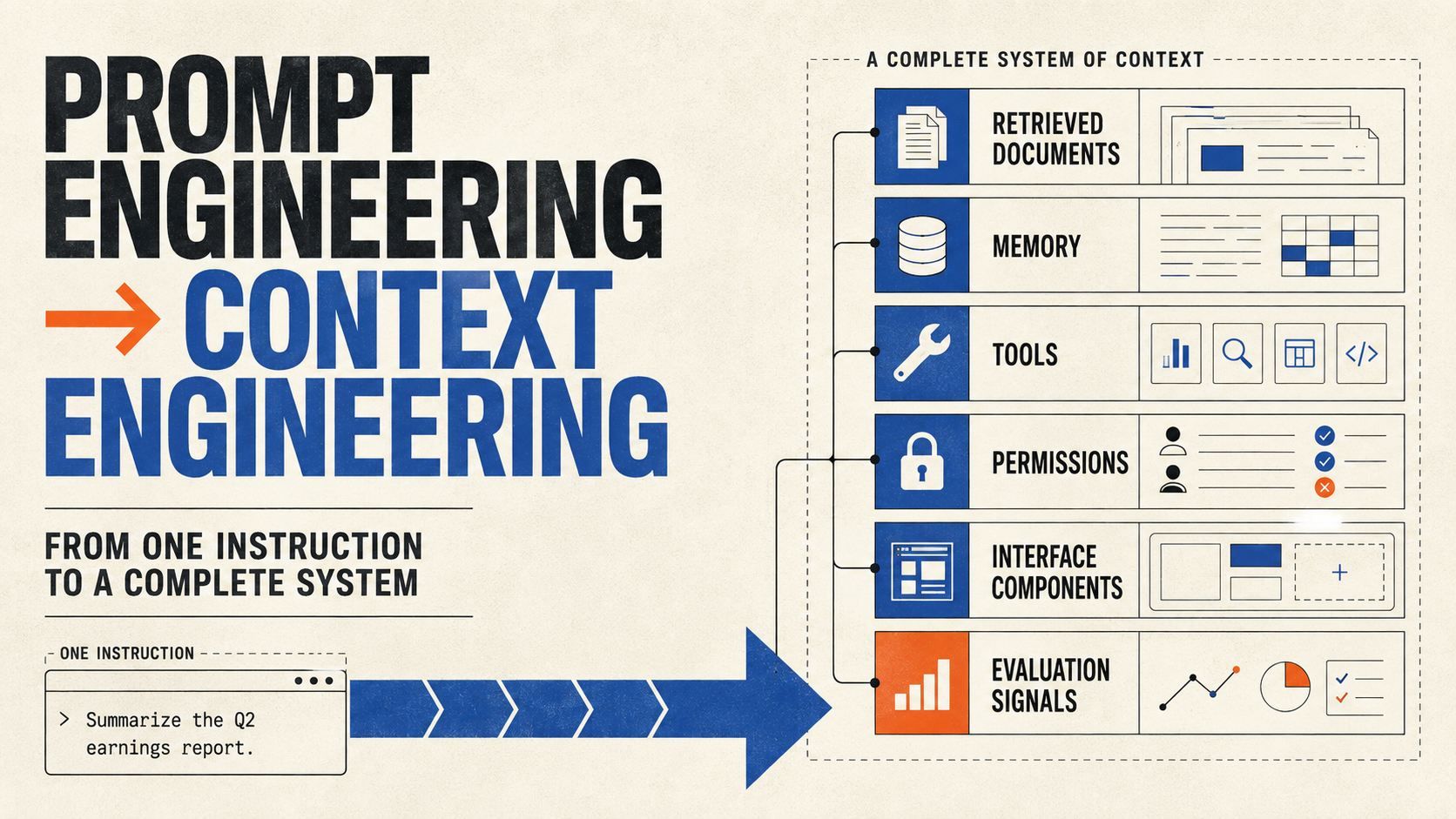
Over the past few years, Prompt Engineering became one of generative AI’s most visible disciplines. People studied role instructions, prompt order, few-shot examples, and libraries of templates ready to copy and paste.
But as AI moved into search, customer support, content management, web design, and automated workflows, a carefully written prompt stopped being enough to support a reliable product.
What Is Prompt Engineering?
are still the start
Prompt Engineering is the practice of designing, organizing, and testing model inputs so a large language model can perform a task more consistently. A prompt may define a role, goal, background, reference material, constraints, output format, examples, and a task sequence.
Early Prompt Engineering focused on finding a more effective way to ask. Those techniques still matter, but they have moved from being the whole solution to becoming one layer inside a larger AI system.
From Prompt to Context: The Key Evolution
Natural language becomes a programming interface
The Transformer established the foundation for modern language models. GPT-3 showed that a few examples could drive translation, classification, summarization, and generation without task-specific retraining.
Prompts begin to shape reasoning processes
Chain-of-Thought encouraged multi-step reasoning, while ReAct let models alternate between reasoning and action. Prompts began to control a process, not just a response.
Retrieval, tools, and programmable prompts
RAG brought external knowledge into the model’s context. Automatic prompt optimization and systems such as DSPy pushed prompting from handcrafted prose toward testable, optimizable modules.
AI agents and Context Engineering
Models can now search, call APIs, operate browsers, and continue multi-step tasks. System behavior depends on data, memory, tools, permissions, execution state, and evaluation—not only the prompt.
What Does Context Engineering Add?
Context Engineering is the discipline of continuously selecting, organizing, and assembling the information a model needs to complete a task within a limited context window.
System rules, roles, task goals, output formats, and prohibited actions.
Current information retrieved from documents, websites, search, and databases.
Conversation history, user preferences, task progress, and necessary short- or long-term memory.
Available APIs, search, browsers, code execution, and the rules for using each capability.
Permissions, safety policies, human confirmation, output validation, and failure handling.
Quality metrics, test cases, execution logs, and evidence that the system is improving.
Prompt Engineering asks how to write the instruction. Context Engineering asks how to construct the complete world the AI sees when making a decision.
Five Ways Prompt Engineering Is Used on the Web
Building websites from prompts
Generative tools can produce information architecture, layouts, front-end components, brand copy, and SEO drafts. Their greatest value is compressing the distance from idea to prototype. Production still requires brand rules, responsive design, performance, accessibility, and verification.
Content, SEO, and AI Search
AI can assist with search intent, topic clustering, outlines, FAQs, localization, and content refreshes. But Google still emphasizes content that helps users. Publishing more is not the same as earning lasting visibility; trusted sources and original value remain central.
Site search, support, and recommendations
Users can describe a need in natural language while AI interprets the intent, queries products or documents, and explains the tradeoffs. The result depends on data quality, retrieval, permissions, and error handling more than on one perfect prompt.
Personalization and Generative UI
AI can choose a comparison table, itinerary, form, chart, or action control instead of returning only prose. Reliable implementations usually compose approved design-system components rather than generating arbitrary code and unpredictable interactions.
Web agents and operable websites
Agents can compare products, book services, fill forms, or work inside admin systems. Semantic HTML, stable component state, labels, structured data, and least-privilege access directly affect whether those tasks can be completed safely.
A website no longer returns only an answer. It can return the interface best suited to completing the task.
Generative UI moves the web from fixed pages toward contextual interfaces. The more freedom an interface has, the more it needs component allowlists, state validation, reversible actions, and human control.
Risks Prompt Engineering Cannot Solve by Itself
Prompt Injection
Malicious instructions can hide in webpages, documents, and retrieved data, pushing a model to ignore rules, expose information, or perform unauthorized actions.
Excessive Automation
Models can produce convincing but incorrect output. Direct publishing, data changes, or transactions can turn a response error into real-world damage.
Privacy and Memory
More context is not always better. Systems must define which data is necessary, how long it is retained, and whether users can review, correct, or delete it.
Unpredictable Interfaces
Without a design system and state constraints, a generated interface may leave users unsure what is happening or unable to reverse a mistaken action.
Web products also need separation between data and instructions, tool allowlists, least privilege, confirmation for consequential actions, input and output validation, and complete audit logs. See the OWASP Prompt Injection guidance.
Past, Present, and Future
| Stage | Core question | Main approach | Role on the web |
|---|---|---|---|
| Past | How do we make the model produce the answer we want? | Roles, few-shot examples, prompt templates | AI acts as a text generator inside a website |
| Present | How can AI complete the whole task reliably? | RAG, tool calling, agents, evaluations | AI connects content, data, and workflows |
| Future | How can AI keep acting within the right context and authority? | Context Engineering, memory, Generative UI | The web serves both humans and AI agents |
From templates to testable systems
Prompts will be versioned, evaluated, and optimized against explicit success criteria instead of judged only by whether an answer feels good.
From chat boxes to generated interfaces
AI will select a more useful interaction form instead of forcing every task into a conversational transcript.
From human-first to dual-readable
Semantic structure, content interfaces, and safe action flows will consider people, search engines, and agents together.
Prompt Engineering Isn’t Disappearing. It Is Becoming Product Design.
Prompt Engineering began as a writing technique, but it is becoming a product capability that crosses content, UX, front-end development, data governance, and AI safety.
The question worth investing in is no longer whether we can discover a perfect prompt. It is whether we can build an AI system that remains reliable, safe, and improvable even when the prompt is imperfect.
The prompt is the starting point. Context is where AI begins to understand and operate the web.
FAQ
Will Prompt Engineering disappear?
No. Instruction design still matters, but product quality increasingly depends on data, tools, context management, permissions, and evaluation.
What is the difference between Prompt Engineering and Context Engineering?
Prompt Engineering primarily designs the instruction given to a model. Context Engineering manages everything needed to complete the task, including conversation history, external data, tool results, memory, permissions, and system state.
Can AI build a complete website automatically?
AI can rapidly generate prototypes, layouts, code, and content. Production websites still require human judgment around brand strategy, information architecture, usability, accessibility, performance, security, and factual review.
Does Prompt Engineering still help SEO?
Yes. It can support intent research, content planning, and page updates. Accuracy, originality, and whether the page solves a real user problem still matter more than generation speed.
What is the biggest risk when adding AI agents to a website?
Major risks include prompt injection, incorrect actions, data exposure, excessive permissions, and unpredictable output. Websites should limit authority, validate actions, and require human confirmation for consequential operations.